Individuelle Reisen nach Jordan — Petra & Wadi Rum
The rose-red city and Mars on Earth.
Was ist eine Individualreise nach Jordan — Petra & Wadi Rum?
Petra is best visited from March to May and September to November (20–28°C). The Treasury is best at 6 a.m. — arrive before the gates open at 6 a.m. if possible, or be first in line. The Monastery requires 800 steps — start by 9 a.m. before the heat. Wadi Rum desert camp overnight for stargazing. The Dead Sea is 3 hours north of Petra. Book 'Petra by Night' (Monday, Wednesday, Thursday) separately from the day ticket.
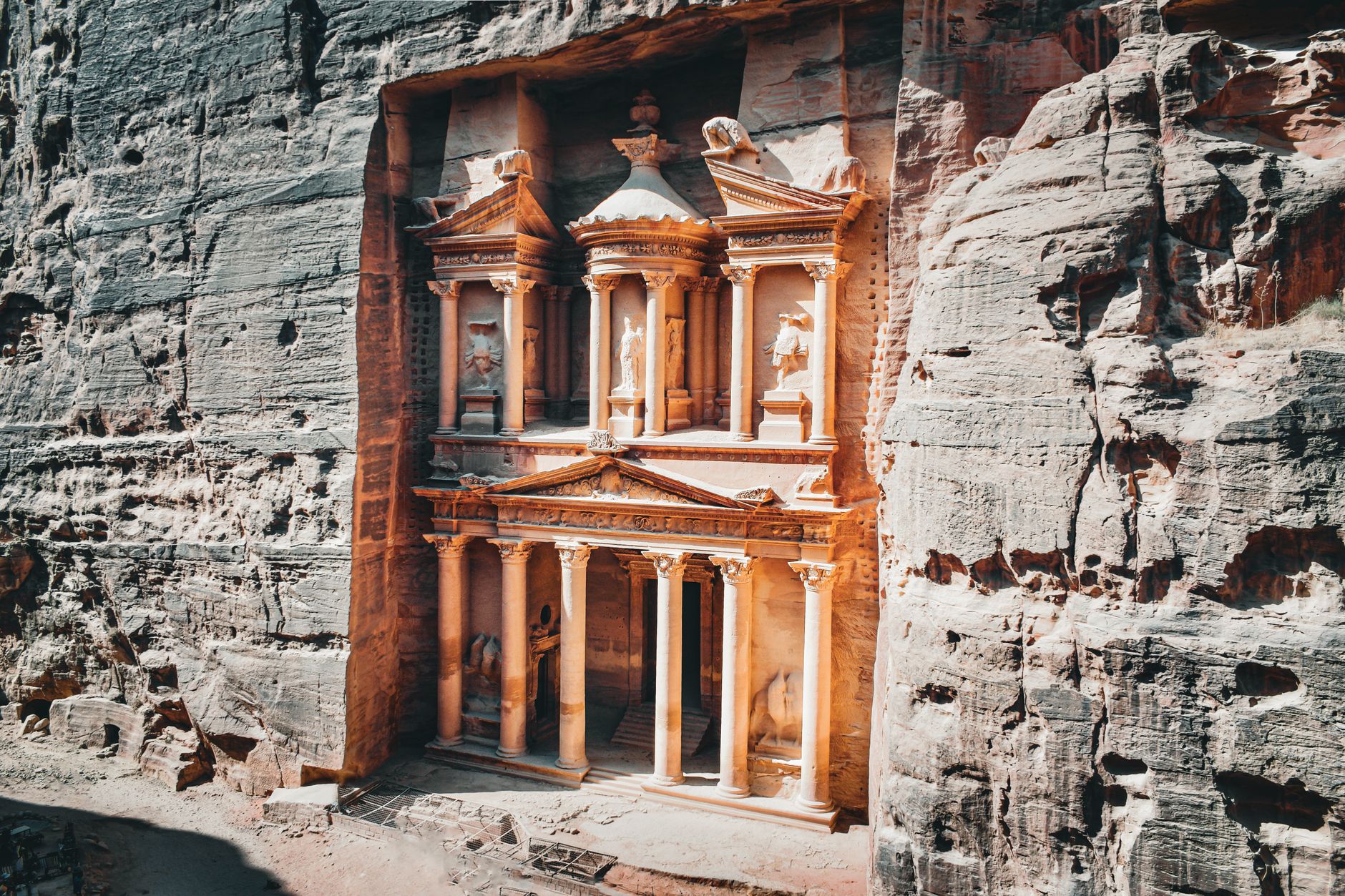
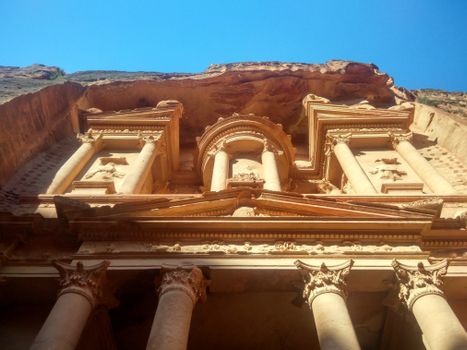
Petra is the ancient capital of the Nabataean Kingdom — a trading empire that controlled the frankincense and spice routes from the Arabian Peninsula to the Mediterranean from the 4th century BCE to 106 CE when Rome annexed the region. The Nabataeans carved their entire city into rose-red Nubian sandstone in the Jordanian desert, producing 800+ monuments, temples, tombs, and water channels in a valley system protected by towering cliffs. The Treasury (Al-Khazneh) — the 40-metre Hellenistic facade carved from a single rock face — is the visual symbol of Petra and the first thing visitors see after the 1.2 km Siq (a narrow canyon whose walls narrow to 2 metres in places and reach 90 metres in height). The Treasury is best experienced at 6 a.m. when it catches the first angled light from the east and the few other visitors are still in the Siq.
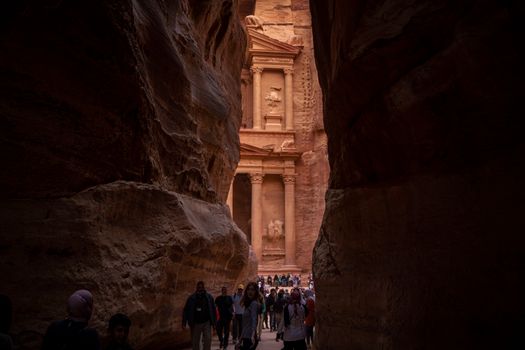
Petra's geography is designed for exploration at multiple scales. The Siq approach (Petra's visitor entrance) is already an experience before the Treasury appears: the canyon walls show Nabataean water channels carved at 3 metres height, lion-headed water spouts still intact after 2,000 years, and a camel caravan bas-relief that marks the Nabataean trade season arrival. Beyond the Treasury, the inner city reveals itself in layers: the Colonnaded Street (Roman-era), the Qasr el-Bint temple (the largest free-standing structure in Petra), the Byzantine Church with its original 6th-century mosaic floor intact, and the climb to the High Place of Sacrifice (a 45-minute ascent via the Wadi Farasa route) that provides the aerial view of the entire valley. The Monastery (Ad-Deir) — larger than the Treasury, reached by 800 rock-cut steps, with a terrace that looks over the Jordanian desert to the Saudi border — is Petra's second great facade and sees far fewer visitors than the Treasury.
Jordan's Wadi Rum desert (120 km south of Petra) is the companion landscape: 74,000 hectares of sandstone and granite mountains rising 1,754 metres from an orange-sand desert floor. Lawrence of Arabia based his Arabian campaigns from the Wadi Rum valleys in 1917–1918, and the landscape's scale and colour (Martian-red, due to iron oxide in the sandstone) led to its selection as the Mars surface location in 'The Martian' (2015) and 'Star Wars: Rise of Skywalker' (2019). A night in a Bedouin camp in Wadi Rum with no light pollution gives the densest star field visible from any inhabited landscape in the Middle East.
Was ist die beste Reisezeit für Jordan — Petra & Wadi Rum?
Unsere empfohlenen Monate sind March–May, September–November. Hier ein monatlicher Überblick mit Planungshinweisen.
Highlights in Jordan — Petra & Wadi Rum
Handverlesene Erlebnisse unserer lokalen Veranstalter. Jede Individualreise beinhaltet eine Auswahl davon — oder etwas noch Besseres.


Musterreiserouten
Zwei Ausgangspunkte — Ihre echte Reiseroute ist individuell. Wir bauen darauf auf.
7 Tage Klassiker
- 1Tag 1: Arrival Aqaba or Amman — Transfer to PetraFly into Aqaba (Queen Alia Airport or Aqaba King Hussein Airport) or Amman (AMM, 3-hour drive to Petra). The Desert Highway south from Amman through the Wadi Araba is Jordan's geological spine — the Rift Valley visible as a descent from the Jordanian plateau to the Dead Sea depression (430 m below sea level, the lowest point on earth). Wadi Musa (Moses Valley) is the town outside the Petra archaeological zone. Hotel check-in. Walk the town in the afternoon, buy a Petra 2-day ticket (strongly recommended over the 1-day — the site requires at minimum 2 full days to see properly). Optional: Petra by Night (Monday, Wednesday, Thursday evenings, separate ticket) — the Siq lit by 1,500 candles and the Treasury illuminated by candlelight, with Bedouin music in the courtyard. The experience is atmospheric but brief (1.5 hours). Evening: dinner of mansaf (Jordan's national dish — lamb slow-cooked in jameed fermented dried yoghurt, served over rice and flatbread, communally eaten with the right hand) at a Wadi Musa restaurant.
- 2Tag 2: Petra — The Siq and Treasury at 6 a.m.At the Petra Visitor Centre gates at 6 a.m. (opening time) — position yourself to be first into the Siq. The 1.2 km narrow canyon is dark until the sun angle reaches over the cliff walls at 7:30 a.m. The water channels at 3 metres height are the Nabataeans' greatest practical achievement — a ceramic pipe system and carved channel fed spring water 8 km from Ain Musa (Moses Spring) into the city, supplying 30,000 residents in a rainless desert. At the Siq's end, the Treasury appears as a vertical slice of rose-red rock through the canyon exit — begin with the full facade view (stand 30 metres back for the complete composition), then approach the carved portal. The Treasury interior is a bare chamber — the elaborate exterior was the statement, the interior was a royal tomb. By 8 a.m. the tour groups begin arriving. Move on: the Street of Facades (45 Nabataean tombs carved in rows), the Theatre (3,000-seat Roman theatre carved entirely from rock), the Urn Tomb, the Corinthian Tomb, the Palace Tomb — the Royal Tombs on the east cliff. Lunch at the Basin Restaurant inside the site (the only sit-down option within the valley, open 12 to 3 p.m.).
- 3Tag 3: Petra — The Monastery (800 Steps, 9 a.m. Start)Start the Monastery trail by 9 a.m. from the Basin Restaurant area — the 800 rock-cut steps take 45 minutes at a steady pace. The path passes the Lion Tomb (carved lion heads flanking the door), the Garden Tomb, and the Hermitage caves before the final staircase. The Ad-Deir (Monastery) facade is 47 metres wide and 48 metres tall — larger than the Treasury. It was likely a Nabataean temple later used as a church by Byzantine monks (the cross carved inside the left chamber suggests Christian reuse). The terrace in front of the Monastery has an unobstructed view southwest toward Wadi Araba, the Negev Desert of Israel, and on very clear days, the Red Sea at Aqaba. A Bedouin tea stall operates from a cave to the right of the facade — sit, drink sweet sage tea, and face the carved rock in silence. Descend by 12 noon before the afternoon heat. Afternoon: the Byzantine Church (original 6th-century mosaic floor depicting personifications of the seasons and geographic regions of the Roman Empire) and the Qasr el-Bint temple (the only large free-standing temple remaining in Petra).
- 4Tag 4: Little Petra and Wadi Rum TransferLittle Petra (Siq al-Barid, 'Cold Canyon', 8 km north of Petra) is a smaller Nabataean suburb — the same carved-sandstone style but with a 2-hour visit window and almost no crowds. The interior of a painted Nabataean biclinium (dining room) has the only painted ceiling surviving in Petra's sites. Drive south to Wadi Rum (120 km, 1.5 hours). Check into a Bedouin desert camp (tents or carved-rock rooms, all are open-air, all face the desert). Afternoon jeep tour of the Wadi Rum valley: Lawrence's Spring (a natural water source in a canyon, visible hand-carved steps leading to the water — Lawrence of Arabia describes refilling his water bags here in 'The Seven Pillars of Wisdom'), the sand dunes at Siq Um Ishrin, and Khazali Canyon (a 500-metre narrow slit canyon with Thamudic and Nabataean petroglyphs carved at head height from camel level — camels carried the carvers). Sunset on a sand dune with the Rum village lit orange in the last light.
- 5Tag 5: Wadi Rum — Stars and Dawn SilenceWadi Rum has zero light pollution within the protected area (the nearest significant settlement is 30 km). The Milky Way is visible from 8:30 p.m. onward — the core of the galaxy appears as a diffuse band 40° across and the density of individual stars exceeds anything visible from inhabited areas in Europe or North America. The Scorpius constellation (summer) or Orion (winter) are so bright they cast a perceptible shadow on bright sand. Dawn in Wadi Rum: the granite and sandstone mountains turn from black to violet to orange in 40 minutes as the sun rises — the colour sequence is geological, driven by the iron oxide content in each rock layer. The morning silence in the desert before the first jeep engine starts is absolute. Breakfast: zarb (Bedouin underground oven — chicken and vegetables cooked in a sealed pot buried in hot coals overnight) eaten in the camp courtyard.
- 6Tag 6: Dead Sea — Float at 430 m Below Sea LevelDrive north from Wadi Rum to the Dead Sea (340 km, 3.5 hours). The Dead Sea (actually a saltwater lake) has a salinity of 34% — 10× more saline than ocean water. The buoyancy is so extreme that swimming strokes have no effect and you lie on the surface regardless. The black mineral mud from the sea floor is applied for its skin properties (high magnesium, sodium, and calcium content). The Dead Sea has lost 30% of its volume since 1960 due to water diversion from the Jordan River — the receding shoreline is visible from the resort area (the current beach is 15 metres lower than the hotel pools). Sunset over the West Bank hills across the water. Hotel at the Dead Sea resort strip (Kempinski, Hilton, or Mövenpick) for the final night.
- 7Tag 7: Amman — Roman Citadel and DepartureAmman is 45 minutes from the Dead Sea. The Roman Citadel (Jebel al-Qal'a) at 8 a.m.: the Temple of Hercules (161 CE, two remaining columns and a massive stone hand — the only surviving part of what would have been a 13-metre statue) and the Umayyad Palace complex (8th century, the earliest Islamic royal residence with a mosaic floor and a domed audience hall). The Jordan Archaeological Museum on the citadel holds the Ain Ghazal statues (PPNB period, 7,250 BCE — 32 plaster statues of human figures, the oldest representational sculptures ever found). The Roman Theatre in downtown Amman (2nd century CE, 6,000 seats, still used for events). Airport transfer for international departure.
14 Tage Tieftauchen
- 1Tag 1: Arrival and Mansaf DinnerWadi Musa hotel. Petra by Night option (Mon, Wed, Thu). Mansaf dinner — lamb in fermented yoghurt over rice.
- 2Tag 2: Siq and Treasury at 6 a.m.First into the Siq. Water channel ceramic pipe system. Treasury at 6:30 a.m. Royal Tombs east cliff. Basin Restaurant lunch.
- 3Tag 3: The Monastery at 9 a.m.800 rock-cut steps. 47 × 48 metre facade. Sage tea terrace with desert view. Byzantine Church mosaics afternoon.
- 4Tag 4: High Place of Sacrifice — Wadi Farasa RouteThe High Place of Sacrifice is a 45-minute ascent via the main steps or the Wadi Farasa western descent route (more scenic, fewer visitors, passes the Lion Fountain and the Roman Soldier Tomb). From the High Place: the full Petra valley below.
- 5Tag 5: Little Petra and Wadi Rum TransferLittle Petra (Siq al-Barid). Painted Nabataean dining room. Wadi Rum camp. Afternoon jeep tour — Lawrence's Spring.
- 6Tag 6: Wadi Rum — Stars and DawnMilky Way from 8:30 p.m. Zero light pollution. Zarb underground oven breakfast. Dawn colour sequence.
- 7Tag 7: Dana Biosphere ReserveDana (between Petra and Wadi Rum) is Jordan's largest nature reserve — 319 km² of four bioclimate zones from Mediterranean oak forest to Wadi Araba desert. The Dana Village (15th century) is a stone settlement on the cliff edge overlooking the Wadi Fidan canyon. The 3-hour Wadi Dana trail descends 1,000 metres from the village to the wadi floor through Nubian sandstone formations with Blanford's fox and Bonelli's eagle sightings.
- 8Tag 8: Aqaba — Coral Reef Snorkel and Red Sea DiveAqaba is Jordan's only Red Sea port (27 km of coastline, the world's northernmost coral reef system). The Aqaba Marine Reserve has pristine coral — the Mohammed Ali dive site (10 minutes from the Aqaba dive centres) has a cedar forest of Acropora coral at 8–15 metres. The Cedar Pride shipwreck (25 metres, deliberately sunk in 1986 as an artificial reef, now fully colonised by hard and soft coral) is Aqaba's best dive.
- 9Tag 9: Dead Sea — Buoyancy and MudDrive from Aqaba to Dead Sea (180 km). Float in 34% salinity. Black mineral mud application. Dead Sea receding shoreline observation — 30% volume lost since 1960.
- 10Tag 10: Madaba and Mount NeboMadaba (30 km from Amman) holds the 6th-century Byzantine mosaic map of the Holy Land — the oldest surviving map of Palestine, 2 million individual tesserae, showing Jerusalem as a walled city with its major churches labelled. Mount Nebo (10 km from Madaba): the site where Moses viewed the Promised Land before his death. The view encompasses the Jordan Valley, Jericho, Jerusalem (on clear days), the Dead Sea, and the West Bank hills.
- 11Tag 11: Jerash — Roman City Second Only to PompeiiJerash (Gerasa) is the most complete Roman provincial city in the world outside Pompeii and Herculaneum: the Oval Plaza, the Cardo Maximus (colonnaded main street, 800 metres long), the South and North Theatres, the Arch of Hadrian (130 CE), and the Hippodrome (all intact). The Jerash Festival of Culture and Arts (July–August) performs live theatre in the Roman South Theatre — the acoustics remain perfect after 2,000 years.
- 12Tag 12: Ajloun Castle and Northern JordanAjloun Castle (1184 CE) was built by Izz al-Din Usama, nephew of Saladin, as a counter-crusader fortress — its position on a hill commands four wadis simultaneously and overlooks the biblical land of Gilead. The surrounding Ajloun Forest Reserve has the last Mediterranean forest in Jordan: oaks, strawberry trees, and wild pistachio.
- 13Tag 13: Amman — Citadel and DowntownRoman Citadel Temple of Hercules. Ain Ghazal plaster statues 7,250 BCE — earliest representational sculpture. Downtown Roman Theatre. Rainbow Street neighbourhood for coffee and Levantine pastry.
- 14Tag 14: Amman Food Day and DepartureHashem Restaurant in Downtown Amman (open since 1952, closes at midnight, falafel and hummus at 6 a.m., frequented by King Abdullah without announcement). Knafeh at Habibah on Prince Mohammed Street — the Nablusite knafeh (shredded wheat, white cheese, rose water, and sugar syrup) that has been served here since 1951. Airport transfer.
Praktische Informationen
Häufig gestellte Fragen
How many days do I need to see all of Petra?+
A minimum of 2 full days for the main highlights: Day 1 for the Siq, Treasury, Street of Facades, and Royal Tombs; Day 2 for the Monastery (800 steps, start by 9 a.m.) and the Byzantine Church. Three days allows the High Place of Sacrifice, Little Petra, the Wadi Muthlim alternative approach (a water channel tunnel walk), and the outer sites (Sabra, Beidha). The 2-day ticket costs significantly less than two 1-day tickets and is the standard recommendation.
Is the Petra by Night experience worth it?+
It depends on expectations. The Siq lit by 1,500 candles and the Treasury illuminated by candlelight is genuinely beautiful. The experience lasts 1.5 hours: a 20-minute walk through the Siq, 45 minutes sitting before the Treasury with Bedouin music, and the return walk. It does not include any site entry beyond the Treasury courtyard. It runs Monday, Wednesday, and Thursday evenings. It is worth doing if you're already buying a 2-day Petra ticket — the additional cost is moderate. It is not a replacement for seeing Petra in daylight.
What is the best time of year to visit Petra?+
March to May is the best season: temperatures of 20–28°C, wildflowers on the plateau above the Siq, and the Jordanian spring light (clear, warm, with low haze). September to November is the second best: similar temperatures, less rain risk than spring. June to August: hot (35–42°C in the valley) but manageable if you start at 6 a.m. and finish by noon. December to February: cold nights (below 5°C) and occasional rain (flash floods in the Siq are possible — the Nabataean water system was built to redirect them, but they still happen in heavy downpours). Check weather forecasts before visiting the Siq in winter.
What is mansaf and how is it eaten?+
Mansaf is Jordan's national dish — lamb slow-cooked in jameed (dried fermented goat's milk, reconstituted to a thin broth with a distinct funky, sour-milk flavour), served over rice with flatbread (markook). The correct serving and eating method: the bread is laid on a large communal plate, rice is poured on top, the lamb pieces are arranged on the rice, and the jameed broth is poured over everything. It is eaten standing around the communal plate, using the right hand to roll rice and meat into a ball. Mansaf is served at weddings, funerals, and significant celebrations — being invited to eat mansaf with a Jordanian family is a significant hospitality gesture.
Can I combine Petra with Wadi Rum and the Dead Sea in one trip?+
Yes — this is the standard Jordan itinerary: Petra (2 days), Wadi Rum (1 night), Dead Sea (1 day), Amman (1 day). Minimum 6 days. Driving distances: Petra to Wadi Rum is 120 km (1.5 hours); Wadi Rum to Aqaba is 60 km (45 minutes); Aqaba to Dead Sea is 300 km (3 hours via Desert Highway); Dead Sea to Amman is 45 minutes. Jordan is compact — the country is 89,342 km² (slightly smaller than Portugal) and the main tourist sites are efficiently connected by road.
Andere fragen auch
- How do I get to Petra from Amman?
- What is inside the Treasury at Petra?
- Is it hard to climb to the Monastery at Petra?
- What is Wadi Rum famous for?
- Can I camp overnight in Wadi Rum?
- What is the best way to see Petra in one day?
- Is Jordan safe for tourists in 2024?
- Can I see the Dead Sea from Petra?
Bereit, Ihre Jordan — Petra & Wadi Rum-Reise zu planen?
Chatten Sie mit unserem KI-Concierge — zwei Minuten für Ihre Traumreise.